Birding in Weymouth
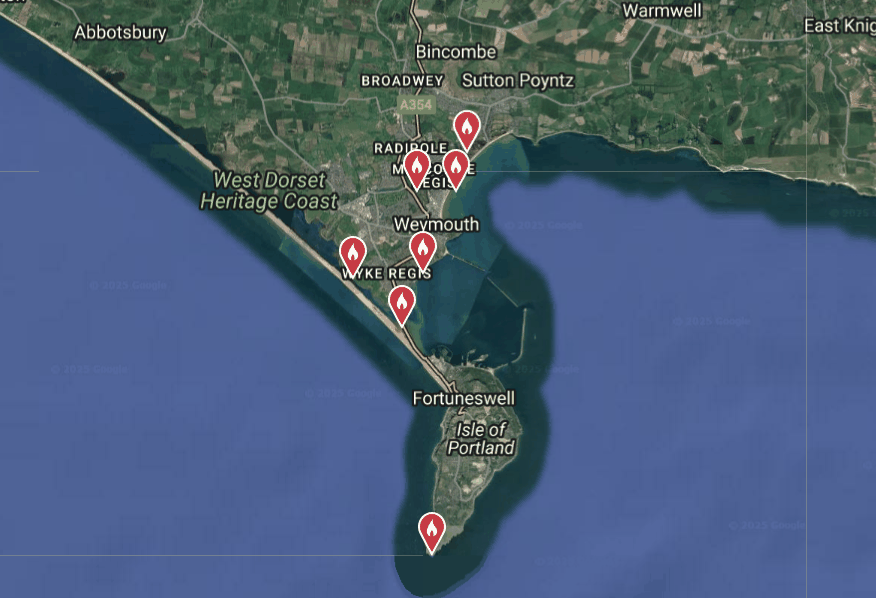
Weymouth is new to me. I googled places to bird in the winter and Weymouth came up as a relatively good location. I checked train tickets and there seemed to be a direct connection from London, so I just decided to go ahead! I’m so glad I came. What an incredible part of the country to go birding in. I didn’t have personal transport for the trip, so I mostly just walked or used the bus. According to my Garmin, I walked about 60 km in around four days (Thursday was a complete washout). So if you enjoy walking, there’s loads to do.
Here’s the the complete ebird list: https://ebird.org/tripreport/461318
Day 1
I took the train from London Waterloo and reached Weymouth at about 1 PM. I dumped my bags at the Airbnb and headed straight for the Lodmoor wetlands. It was cold, but so rewarding! I had brilliant views of a bullfinch pair and a firecrest as I entered. What a joy! Some of the highlights were seven (!!) snipe, literally 100 green-winged teal, and the beautiful, beautiful northern lapwing. Over the reedbeds, a nice male western marsh harrier hovered and hunted. A Cetti’s warbler came out and did its thing. Overall, a super productive evening. I went home exhausted and crashed.
One curious thing I don’t think I’ve seen anywhere else were how the many European Herring gulls hunted. They would pick up shells (presumably with clams) from the water / beach, fly high and then drop them on the payment. The shells would split and the gulls would feed on them. What’s even more weird is that I didn’t see the crows copying that behavior. Crows are incredibly smart so I was quite surprised by that and wonder why that’s the case. Or maybe I didn’t pay enough attention to it?
Day 2
I was up early, made some coffee and a quick cheese sandwich, and planned the day. An interesting geographical feature of Weymouth is the Fleet. The Fleet is the UK’s largest brackish water lagoon. The start of the Fleet is the pebbly storm overflow called Chesil Beach. From lists and trip reports, it seemed to have a strong gathering of birds, so I figured I could get a bus close by and walk.
As I set out, I saw a beautiful peregrine hunting in the morning light. It was FREEZING when I reached the beach, but my first sighting was a lifer: a pair of European shags. As I continued to walk, I was met with dozens of brant. Other highlights that morning included oystercatchers, ruddy turnstone, and skylark. As the sun began to come up, there was a lot more activity. Loads of dunlin and some black-bellied plovers as well.
At around 10:30, I went to the lovely café and had some coffee and a massive slice of apple cake. It was warm and cozy and full of birding people. I then went out for another look to see if anything interesting arrived as the tide started to go out. While standing and scanning, I heard three senior birders discussing the day. When they finished chatting, two of them left, so I asked the remaining gentleman where the grey plovers were. He very kindly pointed them out to me. We struck up a conversation, and it turned out he knew the parents of a person I knew from Kenya (for my Kenya birding homies, he knew Colin Jackson’s parents from back in the day). What an incredibly small world! His name is Nigel and we ended up chatting a bunch. He used to be a vicar and is now living his happy retired life birding Weymouth and the surrounding areas.
Since I didn’t have any transport, Nigel very kindly let me tag along with him to Portland, where we saw common murre, a common gannet, and the usual gulls. As we were preparing to leave, Nigel was convinced there would be purple sandpipers along the coastline. We scanned loads and finally found them. Four beautiful purple sandpipers frolicking in the overflow.
Nigel very kindly dropped me back in Weymouth again. I ate a quick sandwich and made my way back to Lodmoor. I found all the usuals, but also got my first glimpse of a water rail.
Tired and hungry, I got home, chewed Tvisha’s brain about all the birds I’d seen, and crashed.
Day 3
The next day I was up again and ready to go. I walked to Radipole, an RSPB-managed wetland with loads of reeds. Many years ago, I had missed seeing bearded reedlings at Mismere, so I was really keen on them. But given how incredibly shy they are, I didn’t want to focus only on them. There were lots and lots of waterbirds here too. Hundreds of teal, shovelers, and the like.
As I finished the long loop, I stopped to warm up in the sun and struck up a conversation with a lady who was also watching the tufted ducks. She was passing through the reserve on her walk into town. We had a good chat. She’s works on water quality in the Dorset area and told me that bird flu was taking hold. She had found one black-headed gull that looked really sick at Radipole as well.
While chatting with her we heard some excitement down the path. Turns out the bearded reedlings decided to come out in the sun. We were able to see them well, as they scurried up and down feeding on the heads of the reeds.
Post that I went and had a nice large pot of tea and a massive slice of raspberry Bakewell. The best bit about birding is the tea and cake afterwards. Anyway, on my way out, I thought I’d take another look at the pond. I noticed some odd-looking tufted ducks, took a picture, and carried on… turns out they were greater scaup!!!!!
From Radipole, I headed towards Sandsfoot. One bird I was really keen on was the red-breasted merganser. They just looked so odd and cool, and I really wanted to see them—but I kept missing them. I had asked Nigel the day before where I might see them, and he told me he’d seen them that morning at Sandsfoot.
When I reached Sandsfoot, I was really confused. The place seemed to be a castle on the beach that was closed. I looked at the map and saw there was a beach nearby, so I decided to give it a shot. As I reached the beach, I scanned and, WHAT, there were two mergansers!! I was overjoyed.
I had walked a lot and was getting tired, so I decided to walk another three kilometres or so to the bus near Chesil Beach. Once there, I couldn’t help but do a small beach walk. It was the usual, but I managed to pick up a nice curlew. Tired and hungry, I got the bus home.
Day 4
For my final good-weather day, I wanted to walk a lot. So I decided to do the coastal walk on the west side of Weymouth, having already walked loads on the east side earlier. I started early and pretty much walked the whole day. The walk was brilliant, with sunny fields, some mushy mud, but mostly good paths. I walked about 20 km in total and had a massive breakfast at a diner.
In terms of birds, it wasn’t super productive. I saw loads of mergansers, though, and added a green sandpiper to my list. On my way back, I passed through Radipole and managed to find some pochard!
Day 5
Day 5 was when Storm Gorreti hit. It was a complete washout. Super rainy, low visibility, and very, very windy. So I stayed indoors at cafés, read a book, and had copious amounts of tea. I felt really grateful to be able to do birding trips like these and wrote a few lines of gratitude:
I’m grateful for the birds above,
In the trees and on the shore,
I’m grateful I get to touch our world
With my feet and a million more
Day 6
I headed back to London after a quick scan on the beach, a pot of tea, and some Welsh cake.